EQUILIBRIO DELLA BARRIERA
CUTANEA DI CANI E GATTI
EQUILIBRIO DELLA BARRIERA CUTANEA DI CANI E GATTI
V-SKIN
ATOPIC
Allercare shampoo

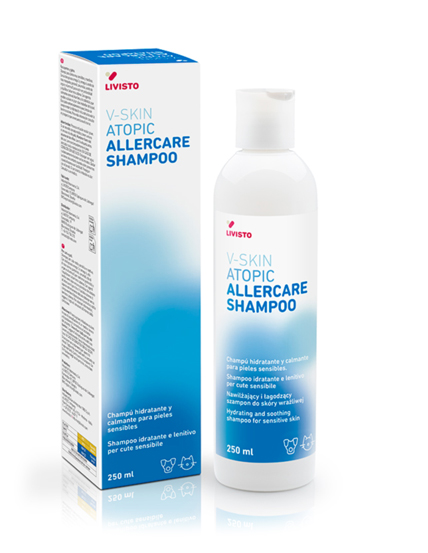
V-SKIN Atopic Allercare shampoo è stato formulato per cuti molto sensibili reattive. Può contribuire a riequilibrare in profondità la barriera cutanea e idratare il derma.
Sapone estremamente delicato che consente una pulizia accurata, senza compromettere l’idratazione e la struttura della barriera cutanea.


Caratteristiche del prodotto
- Contiene olio di argan, acidi grassi omega 3 e omega 6, D-pantenolo, ceramidi e vitamina E, le cui proprietà contribuiscono a riequilibrare e idratare in profondità la barriera cutanea. 1, 2, 3, 4, 5, 6, 7, 8, 9, 10, 11, 12
- Contiene agenti lenitivi come l’aloe vera e la calendula che contribuiscono ad alleviare i fastidi della cute. 13, 14, 15, 16, 17, 18
Come utilizzarlo:
- Bagnare il pelo con acqua tiepida e applicare il prodotto. Massaggiare delicatamente, lasciare agire per 5-10 minuti e risciacquare con abbondante acqua pulita.

Quando utilizzarlo:
- Come complemento in animali sottoposti a trattamenti topici della dermatite atopica, nell’ambito di una terapia prescritta dal medico veterinario, o come shampoo abituale per gli animali domestici che necessitano di una maggiore attenzione alla barriera cutanea. Può essere usato prima di V-SKIN Atopic Prebiotic Spray.
Come utilizzarlo:
- Bagnare il pelo con acqua tiepida e applicare il prodotto. Massaggiare delicatamente, lasciare agire per 5-10 minuti e risciacquare con abbondante acqua pulita.
Guarda il video dell'applicazione del prodotto!
Bibliografia
- Cho YS, Kim HO, Woo SM, Lee DH. Use of Dexpanthenol for Atopic Dermatitis-Benefits and Recommendations Based on Current Evidence. J Clin Med. 2022 Jul 6;11(14):3943. doi: 10.3390/jcm11143943. PMID: 35887707; PMCID: PMC9322723.
- Camargo FB Jr, Gaspar LR, Maia Campos PM. Skin moisturizing effects of panthenol-based formulations. J Cosmet Sci. 2011 Jul-Aug;62(4):361-70. PMID: 21982351.
- Crowther JM. Understanding humectant behaviour through their water-holding properties. Int J Cosmet Sci. 2021 Oct;43(5):601-609. doi: 10.1111/ics.12723. Epub 2021 Aug 4. PMID: 34228831.
- Lin TK, Zhong L, Santiago JL. Anti-Inflammatory and Skin Barrier Repair Effects of Topical Application of Some Plant Oils. Int J Mol Sci. 2017 Dec 27;19(1):70. doi: 10.3390/ijms19010070. PMID: 29280987; PMCID: PMC5796020.
- Vaughn AR, Clark AK, Sivamani RK, Shi VY. Natural Oils for Skin-Barrier Repair: Ancient Compounds Now Backed by Modern Science. Am J Clin Dermatol. 2018 Feb;19(1):103-117. doi: 10.1007/s40257-017-0301-1. PMID: 28707186.
- Kim HJ, Hong JH. Multiplicative Effects of Essential Oils and Other Active Components on Skin Tissue and Skin Cancers. Int J Mol Sci. 2024 May 15;25(10):5397. doi: 10.3390/ijms25105397. PMID: 38791435; PMCID: PMC11121510.
- El Abbassi A, Khalid N, Zbakh H, Ahmad A. Physicochemical characteristics, nutritional properties, and health benefits of argan oil: a review. Crit Rev Food Sci Nutr. 2014;54(11):1401-14. doi: 10.1080/10408398.2011.638424. PMID: 24580537.
- Popa I, Remoue N, Osta B, Pin D, Gatto H, Haftek M, Portoukalian J. The lipid alterations in the stratum corneum of dogs with atopic dermatitis are alleviated by topical application of a sphingolipid-containing emulsion. Clin Exp Dermatol. 2012 Aug;37(6):665-71. doi: 10.1111/j.1365-2230.2011.04313.x. Epub 2012 Feb 23. PMID: 22360796.
- Jung JY, Nam EH, Park SH, Han SH, Hwang CY. Clinical use of a ceramide-based moisturizer for treating dogs with atopic dermatitis. J Vet Sci. 2013;14(2):199-205. doi: 10.4142/jvs.2013.14.2.199. Epub 2013 Jun 21. PMID: 23814473; PMCID: PMC3694192.
- Reiter LV, Torres SM, Wertz PW. Characterization and quantification of ceramides in the nonlesional skin of canine patients with atopic dermatitis compared with controls. Vet Dermatol. 2009 Aug;20(4):260-6. doi: 10.1111/j.1365-3164.2009.00759.x. PMID: 19659537.
- Chermprapai S, Broere F, Gooris G, Schlotter YM, Rutten VPMG, Bouwstra JA. Altered lipid properties of the stratum corneum in Canine Atopic Dermatitis. Biochim Biophys Acta Biomembr. 2018 Feb;1860(2):526-533. doi: 10.1016/j.bbamem.2017.11.013. Epub 2017 Nov 22. PMID: 29175102.
- Miller J, Simpson A, Bloom P, Diesel A, Friedeck A, Paterson T, Wisecup M, Yu CM. 2023 AAHA Management of Allergic Skin Diseases in Dogs and Cats Guidelines. J Am Anim Hosp Assoc. 2023 Nov 1;59(6):255-284. doi: 10.5326/JAAHA-MS-7396. PMID: 37883677.
- Hekmatpou, D., Mehrabi, F., Rahzani, K., & Aminiyan, A. (2019). The effect of aloe vera clinical trials on prevention and healing of skin wound: A systematic review. In Iranian Journal of Medical Sciences (Vol. 44, Issue 1).
- Sánchez, M., González-Burgos, E., Iglesias, I., & Gómez-Serranillos, M. P. (2020). Pharmacological update properties of aloe vera and its major active constituents. In Molecules (Vol. 25, Issue 6). https://doi.org/10.3390/molecules2506132
- Teplicki, E., Ma, Q., Castillo, D. E., Zarei, M., Hustad, A. P., Chen, J., & Li, J. (2018). The effects of aloe vera on wound healing in cell proliferation, migration, and viability. Wounds, 30(9).
- Tresch, M., Mevissen, M., Ayrle, H., Melzig, M., Roosje, P.; Walkenhorst, M. (2019). Medicinal plants as therapeutic options for topical treatment in canine dermatology? A systematic review. BMC Veterinary Researc, (1). https://doi.org/10.1186/s12917-019-1854-4
- Kamr, A., Arbaga, A., El-Bahrawy, A., Elsify, A., Khaled, H., & Hassan, H. (2020). The therapeutic efficacy of Aloe vera gel ointment on staphylococcal pyoderma in dogs. Veterinary World, 13(11). https://doi.org/10.14202/VETWORLD.2020.2371-2380
- John, R.; Jan, N. (2017). Calendula Officinalis-An Important Medicinal Plant with Potential Biological Properties. Proceedings of the Indian National Science Academy,(0). https://doi.org/10.16943/ptinsa/2017/49126

 Sul nostro sito web utilizziamo i cookie per offrirvi l'esperienza più pertinente possibile, ricordando le vostre preferenze e le vostre visite ripetute. Facendo clic su “Accetta”, si acconsente all'utilizzo di TUTTI i cookie. Tuttavia, è possibile visitare le Impostazioni dei cookie per fornire un consenso controllato.