Spray przeciw łuszczeniu
skóry dla psa i kota
Spray przeciw łuszczeniu skóry dla psa i kota
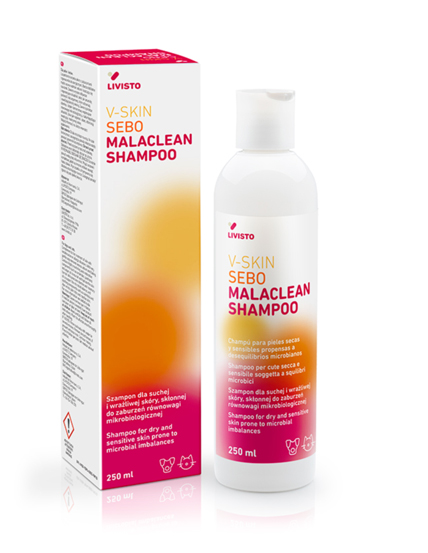
V-SKIN
SEBO
Malaclean shampoo

Środek wspierający pielęgnację skóry ze skłonnością do zaburzeń rogowacenia. Pomaga usuwać nadmiar sebum i złuszczony naskórek, a zawarte składniki o działaniu oczyszczającym wspierają utrzymanie równowagi mikrobiologicznej skóry. Formuła została opracowana z troską o naturalną barierę ochronną skóry.
Formuła oparta na wyjątkowo łagodnych składnikach myjących, wspiera regenerację skóry i zapewnia jej intensywne nawilżenie.


Najważniejsze kwestie:
- Zawiera silnie odżywcze i regenerujące składniki – ceramidy, D-pantenol oraz olej arganowy – które wspierają odbudowę i nawilżenie bariery skórnej. 1, 2, 3, 4, 5, 6, 7, 8, 9, 10, 11, 12
- Dzięki piroktonowi olaminy i olejkowi rozmarynowemu pomaga utrzymać równowagę mikrobiologiczną skóry. 13, 14, 15, 16, 17, 18, 19, 20
- Zawiera składniki pochodzenia roślinnego, takie jak nagietek i aloes, które wspierają pielęgnację skóry skłonnej do podrażnień i pomagają łagodzić uczucie świądu. 21, 22, 23, 23, 25, 26
Sposób użycia:
- Zwilżyć sierść letnią wodą, nałożyć preparat i delikatnie wmasować. Pozostaw na 5–10 minut, a następnie dokładnie spłukać obficie czystą wodą.

Kiedy stosować:
- Jako uzupełnienie pielęgnacji skóry atopowej z objawami łuszczenia lub łojotoku. Idealny do stosowania przed aplikacją sprayu V-SKIN Sebo Gluco Zinc w celu oczyszczenia skóry i sierści.
Sposób użycia:
- Zwilżyć sierść letnią wodą, nałożyć preparat i delikatnie wmasować. Pozostaw na 5–10 minut, a następnie dokładnie spłukać obficie czystą wodą.
Obejrzyj materiał wideo dotyczący stosowania produktu!

Bibliografia
- Cho YS, Kim HO, Woo SM, Lee DH. Use of Dexpanthenol for Atopic Dermatitis-Benefits and Recommendations Based on Current Evidence. J Clin Med. 2022 Jul 6;11(14):3943. doi: 10.3390/jcm11143943. PMID: 35887707; PMCID: PMC9322723.
- Camargo FB Jr, Gaspar LR, Maia Campos PM. Skin moisturizing effects of panthenol-based formulations. J Cosmet Sci. 2011 Jul-Aug;62(4):361-70. PMID: 21982351.
- Crowther JM. Understanding humectant behaviour through their water-holding properties. Int J Cosmet Sci. 2021 Oct;43(5):601-609. doi: 10.1111/ics.12723. Epub 2021 Aug 4. PMID: 34228831.
- Lin TK, Zhong L, Santiago JL. Anti-Inflammatory and Skin Barrier Repair Effects of Topical Application of Some Plant Oils. Int J Mol Sci. 2017 Dec 27;19(1):70. doi: 10.3390/ijms19010070. PMID: 29280987; PMCID: PMC5796020.
- Vaughn AR, Clark AK, Sivamani RK, Shi VY. Natural Oils for Skin-Barrier Repair: Ancient Compounds Now Backed by Modern Science. Am J Clin Dermatol. 2018 Feb;19(1):103-117. doi: 10.1007/s40257-017-0301-1. PMID: 28707186.
- Kim HJ, Hong JH. Multiplicative Effects of Essential Oils and Other Active Components on Skin Tissue and Skin Cancers. Int J Mol Sci. 2024 May 15;25(10):5397. doi: 10.3390/ijms25105397. PMID: 38791435; PMCID: PMC11121510.
- El Abbassi A, Khalid N, Zbakh H, Ahmad A. Physicochemical characteristics, nutritional properties, and health benefits of argan oil: a review. Crit Rev Food Sci Nutr. 2014;54(11):1401-14. doi: 10.1080/10408398.2011.638424. PMID: 24580537.
- Popa I, Remoue N, Osta B, Pin D, Gatto H, Haftek M, Portoukalian J. The lipid alterations in the stratum corneum of dogs with atopic dermatitis are alleviated by topical application of a sphingolipid-containing emulsion. Clin Exp Dermatol. 2012 Aug;37(6):665-71. doi: 10.1111/j.1365-2230.2011.04313.x. Epub 2012 Feb 23. PMID: 22360796.
- Jung JY, Nam EH, Park SH, Han SH, Hwang CY. Clinical use of a ceramide-based moisturizer for treating dogs with atopic dermatitis. J Vet Sci. 2013;14(2):199-205. doi: 10.4142/jvs.2013.14.2.199. Epub 2013 Jun 21. PMID: 23814473; PMCID: PMC3694192.
- Reiter LV, Torres SM, Wertz PW. Characterization and quantification of ceramides in the nonlesional skin of canine patients with atopic dermatitis compared with controls. Vet Dermatol. 2009 Aug;20(4):260-6. doi: 10.1111/j.1365-3164.2009.00759.x. PMID: 19659537.
- Chermprapai S, Broere F, Gooris G, Schlotter YM, Rutten VPMG, Bouwstra JA. Altered lipid properties of the stratum corneum in Canine Atopic Dermatitis. Biochim Biophys Acta Biomembr. 2018 Feb;1860(2):526-533. doi: 10.1016/j.bbamem.2017.11.013. Epub 2017 Nov 22. PMID: 29175102.
- Miller J, Simpson A, Bloom P, Diesel A, Friedeck A, Paterson T, Wisecup M, Yu CM. 2023 AAHA Management of Allergic Skin Diseases in Dogs and Cats Guidelines. J Am Anim Hosp Assoc. 2023 Nov 1;59(6):255-284. doi: 10.5326/JAAHA-MS-7396. PMID: 37883677.
- Esmael A, Hassan MG, Amer MM, Abdelrahman S, Hamed AM, Abd-Raboh HA, Foda MF. Antimicrobial activity of certain natural-based plant oils against the antibiotic-resistant acne bacteria. Saudi J Biol Sci. 2020 Jan;27(1):448-455. doi: 10.1016/j.sjbs.2019.11.006. Epub 2019 Nov 20. PMID: 31889869; PMCID: PMC6933203.
- Issabeagloo E., Kermanizadeh P., Taghizadieh M., Forughi R. Antimicrobial effects of rosemary (Rosmarinus officinalis L.) essential oils against Staphylococcus spp. African J. Microbiol. Res. 2012;6:5039–5042.
- Jiang Y, Wu N, Fu YJ, Wang W, Luo M, Zhao CJ, Zu YG, Liu XL. Chemical composition and antimicrobial activity of the essential oil of Rosemary. Environ Toxicol Pharmacol. 2011 Jul;32(1):63-8. doi: 10.1016/j.etap.2011.03.011. Epub 2011 Mar 30. PMID: 21787731.
- Dall’Oglio F, Tedeschi A, Fusto CM, Lacarrubba F, Dinotta F, Micali G. A novel cosmetic antifungal/anti-inflammatory topical gel for the treatment of mild to moderate seborrheic dermatitis of the face: an open-label trial utilizing clinical evaluation and erythema-directed digital photography. G Ital Dermatol Venereol. 2017;152:436–440.
- Piquero-Casals J, La Rotta-Higuera E, Francisco Mir-Bonafé J, Rozas-Muñoz E, Granger C. Non-Steroidal Topical Therapy for Facial Seborrheic Dermatitis. J Drugs Dermatol. 2020 Jun 1;19(6):658-660. doi: 10.36849/JDD.2020.10.36849/JDD.2020.5121. PMID: 32574015.
- Piquero-Casals J, Hexsel D, Mir-Bonafé JF, Rozas-Muñoz E. Topical Non-Pharmacological Treatment for Facial Seborrheic Dermatitis. Dermatol Ther (Heidelb). 2019 Sep;9(3):469-477. doi: 10.1007/s13555-019-00319-0. Epub 2019 Aug 8. PMID: 31396944; PMCID: PMC6704200.
- Granger C, Goni F, Martinez G, Garre A. Ex-vivo determination of antifungal activity of a new prescription non-steroidal facial cream against Malassezia furfur in human skin explants. Skin J Cutan Med. 2017;1:137. doi: 10.25251/skin.1.supp.136.
- Dall’Oglio F, Nasca MR, Gerbino C, Micali G. An Overview of the Diagnosis and Management of Seborrheic Dermatitis. Clin Cosmet Investig Dermatol. 2022 Aug 6;15:1537-1548. doi: 10.2147/CCID.S284671. PMID: 35967915; PMCID: PMC9365318.
- Hekmatpou, D., Mehrabi, F., Rahzani, K., & Aminiyan, A. (2019). The effect of aloe vera clinical trials on prevention and healing of skin wound: A systematic review. In Iranian Journal of Medical Sciences (Vol. 44, Issue 1).
- Sánchez, M., González-Burgos, E., Iglesias, I., & Gómez-Serranillos, M. P. (2020). Pharmacological update properties of aloe vera and its major active constituents. In Molecules (Vol. 25, Issue 6). https://doi.org/10.3390/molecules2506132
- Teplicki, E., Ma, Q., Castillo, D. E., Zarei, M., Hustad, A. P., Chen, J., & Li, J. (2018). The effects of aloe vera on wound healing in cell proliferation, migration, and viability. Wounds, 30(9).
- Tresch, M., Mevissen, M., Ayrle, H., Melzig, M., Roosje, P.; Walkenhorst, M. (2019). Medicinal plants as therapeutic options for topical treatment in canine dermatology? A systematic review. BMC Veterinary Researc, (1). https://doi.org/10.1186/s12917-019-1854-4
- Kamr, A., Arbaga, A., El-Bahrawy, A., Elsify, A., Khaled, H., & Hassan, H. (2020). The therapeutic efficacy of Aloe vera gel ointment on staphylococcal pyoderma in dogs. Veterinary World, 13(11). https://doi.org/10.14202/VETWORLD.2020.2371-2380
- John, R.; Jan, N. (2017). Calendula Officinalis-An Important Medicinal Plant with Potential Biological Properties. Proceedings of the Indian National Science Academy,(0). https://doi.org/10.16943/ptinsa/2017/49126

 Używamy plików cookie na naszej stronie internetowej, aby zapewnić Ci najbardziej odpowiednie wrażenia poprzez zapamiętywanie Twoich preferencji i powtarzanie wizyt. Klikając „Akceptuj”, użytkownik wyraża zgodę na używanie WSZYSTKICH plików cookie. Możesz jednak odwiedzić Ustawienia plików cookie, aby wyrazić kontrolowaną zgodę.